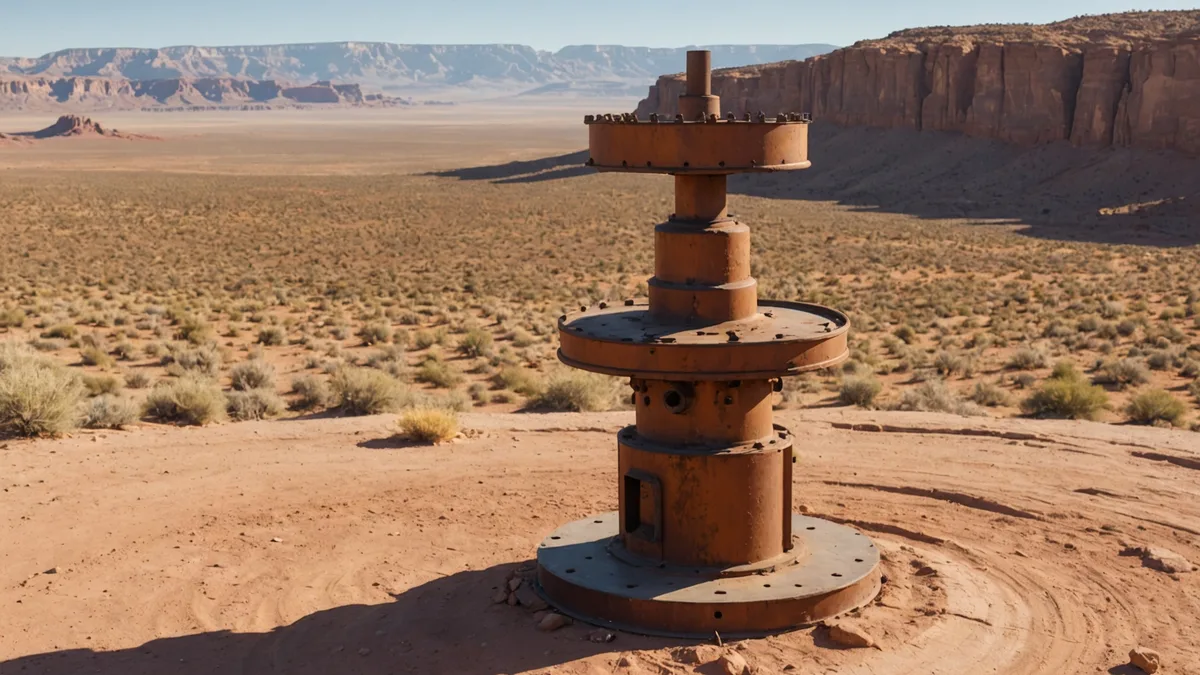
There are wells scattered across the Western US that were drilled at significant cost, found hot rock instead of hydrocarbons, and were plugged and abandoned. Nobody was interested in hot rock when oil prices justified drilling to those depths. The wells were recorded, permitted, plugged, and forgotten. The heat below them continued to conduct upward at the same rate it has for millions of years.
We built a business around the observation that those wells are not actually abandoned. They are pre-drilled access points to thermal resources that existing technology now makes economically extractable. The geological investment was made decades ago. The question is whether the surface economics have caught up to the subsurface reality.
What Shut-In Wells Are and How They Accumulate
A shut-in well is a wellbore that has been drilled, completed, and then taken out of production or abandoned without being permanently plugged. In the oil and gas industry, wells are shut in for various reasons: the reservoir is not commercially productive at current prices, the operator has gone bankrupt, the equipment needs repair, or the field has been sold and the new owner is evaluating development options. When a well is not commercially viable and the operator does not see a path to production, the regulatory trajectory usually ends in a plugged and abandoned designation.
For our purposes, the relevant category is wells in the Basin and Range province and adjacent formations that were drilled to depths of 1,000 to 4,000 meters, encountered hot rock rather than productive hydrocarbon zones, and were plugged and abandoned. There are also wells in this region from 1970s and 1980s geothermal exploration programs that were completed and temperature-logged but never brought into production because the economics of conventional hydrothermal development did not close at the scale and resource quality found.
The well inventory in Utah alone includes several thousand plugged and abandoned wellbores of various depths and vintages, documented in the Utah Division of Oil, Gas and Mining database. A subset of these, those drilled to depths below about 1,500 meters in geological settings consistent with elevated heat flow, are potentially relevant to our site assessment process. Most are not. The data is imprecise, the records are incomplete for older wells, and many wellbores are in locations or conditions that preclude repurposing. But the useful subset is not trivial.
What a Well Assessment Actually Involves
When we identify a potentially relevant shut-in or abandoned wellbore, the assessment process has several stages. We start with the paper record: what is the completion depth, what lithology was encountered, what temperature data is available from completion reports or any geophysical logs that were run. This initial desk assessment filters out wells that are obviously too shallow, in the wrong formation, or that have documented mechanical issues making them unsuitable for repurposing.
For wells that pass the desk assessment, the next step is a physical inspection and preliminary wellbore integrity check. A wellbore that has been sitting unpressured for 30 years may have casing corrosion, cement degradation at depth, or perforations from the original completion that would allow working fluid to migrate into the formation. Before any geothermal working fluid is introduced to a wellbore, we need confidence in the mechanical integrity of the casing from surface to total depth. This evaluation typically involves a casing inspection log and a pressure test.
If the wellbore passes mechanical integrity review, we run a temperature log using a memory tool on wireline to get current formation temperature measurements at depth. This is the most important data point in the assessment. The temperature log tells us what the formation is actually giving us today, accounting for any thermal disturbance from the original drilling and any recharge that has occurred since the well was shut in. For wells that have been shut in for more than 10 to 15 years, the formation temperature has typically recovered to near-undisturbed conditions.
The Wellbore Repurposing Question
Repurposing a wellbore for closed-loop geothermal heat extraction requires two things that conventional oil and gas completions were not designed for: a continuous sealed conduit from surface to target depth that can carry working fluid under pressure, and a wellbore geometry that maximizes the contact area between the working fluid conduit and the formation rock.
The casing itself, if in good condition, can serve as the outer conductor of a coaxial pipe-in-pipe system. The working fluid is circulated down the inner pipe, heats by conduction through the annulus between the inner and outer pipe, and returns to the surface through the annulus. This is a simplification of the actual wellbore heat exchanger geometry, which varies by manufacturer and application, but it captures the essential concept.
The complication is that most oil and gas wellbores were completed with production casing designed for specific formation pressures and fluid chemistry, not for the temperature cycling that comes with continuous geothermal heat extraction over a 20 to 30-year operational life. Casing steel grades that are adequate for oil and gas production may require supplemental corrosion treatment or full recasing to meet the mechanical requirements of geothermal operation. Each well has to be evaluated on its specific completion record.
For wells where repurposing is not mechanically feasible, we evaluate whether the existing wellbore can serve as a directional target. A new directional well drilled from a small surface pad can reach the same target depth as the existing wellbore using the existing geological characterization data as a model for formation temperature prediction. The existing wellbore in this case is not directly repurposed but provides data that substantially reduces exploration risk for the new well.
Regulatory Status of Repurposed Wells
Plugged and abandoned wellbores are regulated by state oil and gas agencies. Repurposing a P&A well for geothermal use requires either obtaining a new permit for geothermal development at the well location, or reopening the existing well permit under a change-of-use application, depending on the state and the specific regulatory history of the well. Utah, Nevada, and Idaho each have different processes for this, and the timeline varies from 3 months to well over a year depending on the complexity of the regulatory history and any surface rights complications.
Federal land adds another layer. A significant fraction of the potentially relevant wellbores in the Basin and Range are on Bureau of Land Management surface, which means geothermal development requires a federal geothermal lease and a permit from BLM in addition to state approval. BLM has been working to streamline geothermal permitting for small modular projects, but the process still takes time. For wells on private surface with state-administered subsurface rights, the timeline is more predictable.
The Economics of a Pre-Drilled Resource
The economic argument for shut-in well repurposing is straightforward when it works: the drilling cost, which typically represents 40 to 60 percent of the total installed cost for a new geothermal well, is reduced or eliminated. If a wellbore passes mechanical integrity review and temperature log and can be prepared for geothermal operation with casing work rather than a new drill program, the capital cost reduction is significant. For a modular unit targeted at a 3,000-meter formation, the difference between drilling a new well and repurposing an existing one can represent $1.5 million to $3 million in capital savings, depending on formation difficulty and casing requirements.
Not every shut-in well pencils out economically. Some require enough recasing work that the cost approaches a new well. Some are in locations that are simply too far from the industrial load to make the surface transmission practical. Some have wellbore geometry that is incompatible with the coaxial heat exchanger configuration. The assessment process exists to distinguish the viable cases from the marginal ones before capital is committed.
The broader point is that the stranded asset problem in oil and gas exploration, the phenomenon of having drilled and found nothing commercially useful, has created a legacy of subsurface access points that the geothermal industry did not pay for and is now beginning to inherit. The heat was always there. The question is whether the economics of extraction have finally caught up to the geology, and for a growing subset of these wells and these sites, they have.
Evaluating geothermal for your industrial site?
We assess formation data and provide a preliminary feasibility overview. No commitment required.
Contact our team