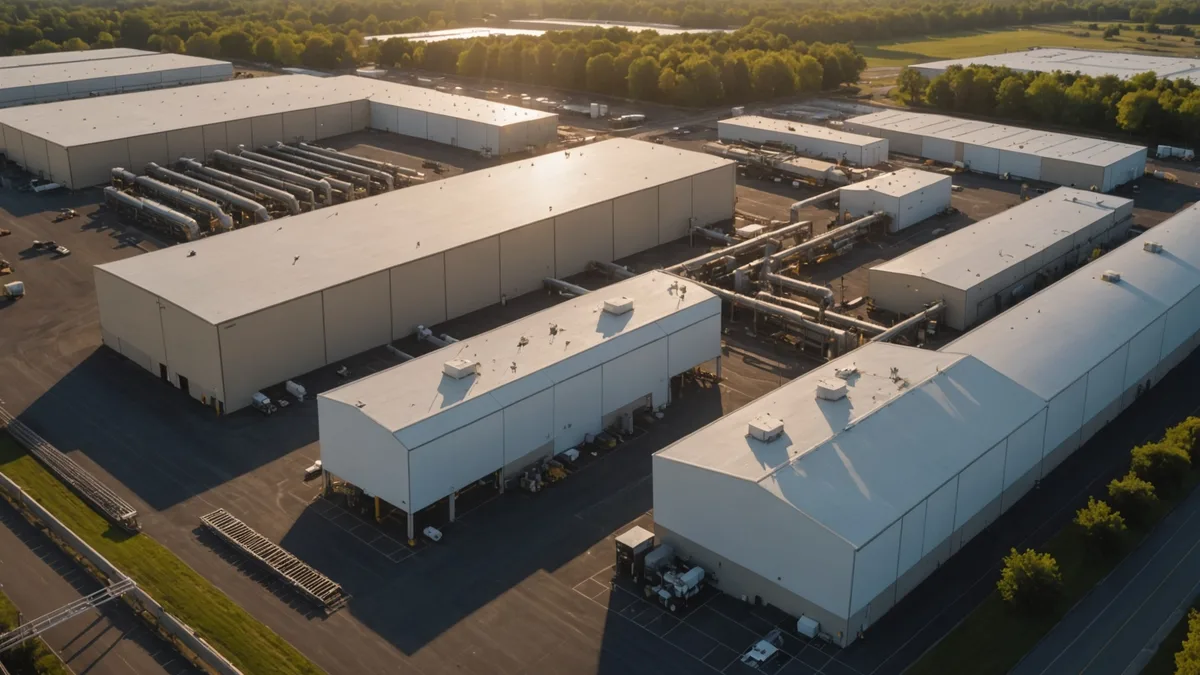
Utility-scale geothermal plants are impressive. The Coso field in California, the Geysers complex, the Wairakei plant in New Zealand: these are major industrial facilities that took years and hundreds of millions of dollars to develop. They are not the right model for a 400,000-square-foot polymer compounding plant in the Utah Basin that needs 6 megawatts of clean baseload and has an 18-month capital planning horizon.
The gap between what exists and what mid-size industrial sites actually need is the problem we are trying to close. This article explains why modular geothermal is architecturally suited to that gap in a way that conventional geothermal development is not.
What "Modular" Actually Means in This Context
Modular is an overloaded word in the energy industry. In the context of our approach, it means three specific things.
First, the surface equipment is skid-mounted and truck-transportable. The heat exchanger assembly, the ORC power unit, the working fluid management system, and the dispatch interface hardware are all designed to be delivered to a site on flatbed trailers and erected with standard crane equipment. This eliminates the requirement for custom-built civil infrastructure at the surface. A conventional geothermal plant has a facility footprint that is appropriate for a long-term power plant. Our surface equipment footprint is appropriate for an industrial equipment installation.
Second, the output capacity is sized to site demand, not to grid economics. A utility-scale geothermal plant is sized to produce economically at the grid level, typically 20 megawatts and up, because that is the scale at which the development economics work when you are selling into a wholesale market. A modular unit is sized to the industrial site's baseload demand, which for mid-scale manufacturing typically falls in the 2 to 12 megawatt range. You are not overbuilding for grid export when what you need is a continuous, reliable on-site generation source.
Third, the subsurface footprint is designed around existing or easily accessible wellbore infrastructure rather than a new field development. This is where the shut-in well strategy becomes important. Instead of drilling a new geothermal well from scratch, we evaluate whether existing wellbores in or near the target site can be repurposed, or whether a new directional well from a small surface location can reach the formation at depth. The drilling scope for a single-well modular unit installation is a fraction of the scope for a conventional multi-well geothermal field.
The Conventional Geothermal Problem at Industrial Scale
The development process for a conventional hydrothermal geothermal project has a characteristic timeline and capital profile that is incompatible with industrial site planning cycles. Exploration, resource characterization, permitting, drilling, surface facilities construction, and interconnection together take 7 to 12 years for a greenfield project. Capital requirements run from $50 million to well over $200 million for a 20-megawatt plant. Power purchase agreement structures for these projects typically require 20-year off-take commitments to make the project finance work.
An industrial manufacturer evaluating energy supply options over a 5-year capital plan horizon cannot rationally commit to a 20-year PPA for a plant that will not be operational for 8 years. The decision never gets made, the diesel generators stay running, and the carbon bill keeps accumulating.
The modular approach compresses the development timeline dramatically. For a site with a suitable existing wellbore and clear subsurface characterization, we are looking at 18 to 24 months from site assessment to first power. For a site requiring a new directional well and full permitting, 24 to 36 months. These are not fast by typical energy project standards, but they are within the planning horizon of mid-size industrial capital budgets.
Unit Economics for Mid-Scale Manufacturing
Consider a hypothetical scenario: a food processing facility in the eastern Utah Basin, operating 24 hours per day, 340 days per year, with a continuous electrical demand of approximately 5.5 megawatts and a process heat demand of roughly 4.5 megawatt-thermal at temperatures in the 80 to 120 degree Celsius range. This is an illustrative scenario based on the characteristics of industrial buyers we have spoken with, not a specific customer case.
At 5.5 megawatts of continuous electrical generation and 4.5 megawatt-thermal of direct heat supply, a modular geothermal unit at this scale would displace approximately 44,000 megawatt-hours per year of grid electricity and provide the equivalent of roughly 36,000 megawatt-hours of process heat per year. At typical industrial electricity rates and natural gas prices in this region, the total annual energy cost offset for a facility like this runs in the range of $2.8 to $4.2 million per year. That is before demand charge mitigation, which adds meaningful additional value for a facility with a high load factor.
The capital cost for a modular unit at this scale, including wellbore work, surface equipment, and interconnection, is a function of formation depth and drilling complexity that varies by site. We do not publish a price list because the geological variables dominate the cost structure. What we can say is that the payback economics at mid-scale manufacturing sites with suitable geology consistently land in the 7 to 12 year range before any carbon pricing, tax incentives, or demand charge credits are factored in. Those factors improve the picture further.
Why the Heat Component Changes the Economics
Most geothermal economics discussions focus exclusively on electricity generation. This is understandable when you are thinking about grid-scale projects, where power sales are the only revenue stream. For industrial sites, the direct heat offtake is often the more compelling economic case.
Industrial process heat in the 80 to 150 degree Celsius range represents a substantial fraction of many manufacturing facilities' total energy costs. Producing that heat electrically is expensive. Producing it from natural gas is subject to gas price volatility and increasingly subject to carbon compliance costs. Producing it directly from a geothermal heat exchanger at constant temperature and zero fuel cost is a structurally different proposition.
For a modular unit, the ability to deliver both electricity and direct process heat from a single wellbore substantially improves the unit economics compared to a pure power generation use case. The thermodynamics work because the working fluid in a binary ORC system rejects heat at temperatures typically in the 50 to 80 degree Celsius range after the power generation stage. That rejected heat, in a conventional power plant, is wasted. In an industrial configuration, it can be the supply stream for low-temperature process heating, building heat, or preheating for higher-temperature processes.
The Deployment Constraint That Still Exists
We want to be clear about what the modular approach does not solve. It does not make geothermal deployable everywhere. The formation temperature constraint is real. In the Basin and Range province, there are zones with accessible gradient that support economical modular development, and there are zones where the gradient is too low at drillable depth. Our site assessment process is designed to determine which category a prospective site falls into before anyone commits capital.
The modular approach also does not compress the permitting timeline to zero. Bureau of Land Management review for wells on or near federal land, state environmental review processes, and interconnection studies still take time. We have become efficient at navigating these processes in Utah, Nevada, and Idaho, but they are not discretionary. A prospective partner should plan for them.
The argument for modular geothermal at mid-scale industrial sites is not that it is easy or fast. It is that it is feasible at a scale and timeline that conventional geothermal development is not, for sites with the right geology, the right load profile, and a planning horizon that can accommodate a 2-year development process. That combination describes more industrial sites in the Western US than most energy planners currently recognize.
Evaluating geothermal for your industrial site?
We assess formation data and provide a preliminary feasibility overview. No commitment required.
Contact our team