The annual geothermal forecast reports from industry associations and national laboratories are useful documents. They are not particularly useful for making site-specific deployment decisions in the Basin and Range province, because they aggregate data at a national or global level that loses the regional detail on which feasibility actually depends. This article is our assessment of what the Basin and Range numbers actually say for 2026 modular deployment, based on publicly available geological data, formation temperature records, and the site-specific work we have been doing in the region.
The Basin and Range Province: Why It Matters
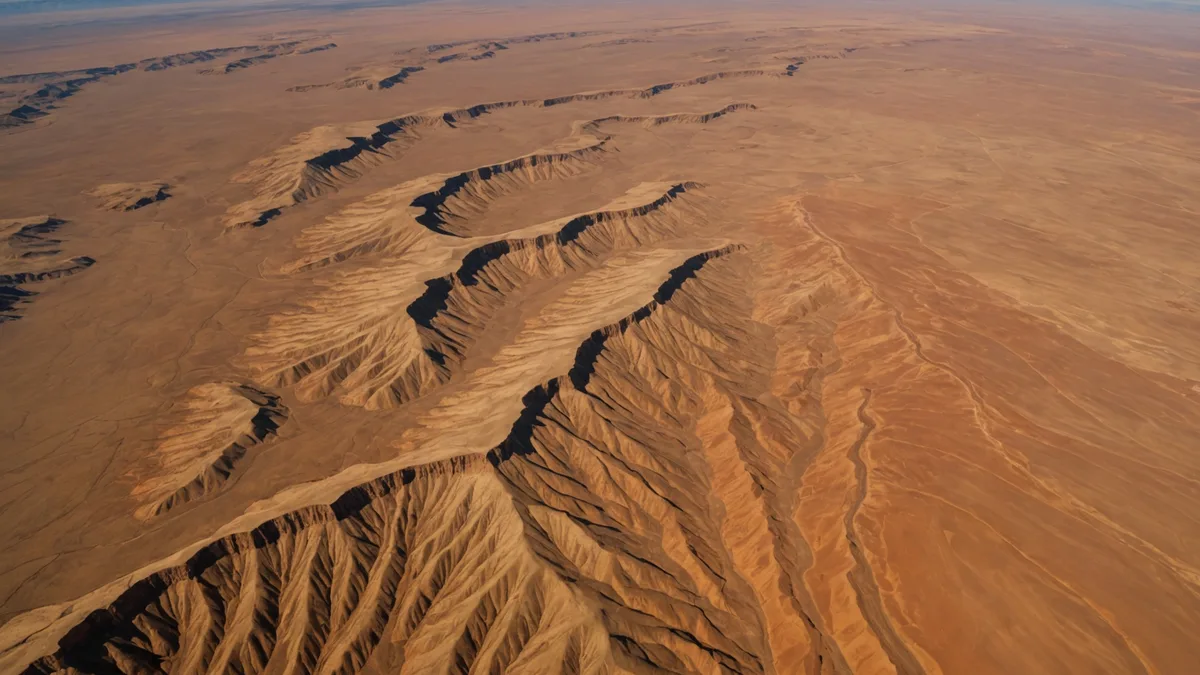
The Basin and Range physiographic province extends from southeastern Oregon and southern Idaho through Nevada, Utah, Arizona, and into Mexico. It is the result of extensional tectonics: the crust in this region has been pulled apart horizontally, thinning the crust and bringing the asthenosphere closer to the surface. The result is elevated heat flow relative to the stable continental interior, higher geothermal gradients than in most other parts of the contiguous United States, and a structural setting that produces accessible thermal resources at economically drillable depths across a large area.
The published estimate for average geothermal gradient in the Basin and Range runs roughly 30 to 45 degrees Celsius per kilometer, compared to the continental average of about 25 to 30 degrees Celsius per kilometer. That difference of 5 to 15 degrees Celsius per kilometer may seem modest in absolute terms, but across a 2,000 to 3,000-meter depth range, it translates to formation temperatures that are 30 to 60 degrees Celsius higher than you would find at equivalent depth in, say, the Appalachian basin. That differential is the difference between a resource that is marginal for binary ORC generation and one that works comfortably.
What the 2025 Data Shows for Modular-Scale Deployment
Based on publicly available temperature gradient data from the Southern Methodist University geothermal lab, USGS well temperature databases, state oil and gas commission records, and our own survey work in the Wasatch Front corridor, we see the following pattern for the Basin and Range in 2025 to 2026.
The eastern Basin and Range (western Utah, southern Nevada) shows the most accessible modular deployment potential because it combines elevated gradients with a relatively dense existing wellbore inventory from historical oil and gas exploration. The gradient values in the 38 to 52 degrees Celsius per kilometer range that we have documented in our Wasatch Front survey work are consistent across this sub-region, with higher values near documented volcanic features.
The central Basin and Range (central and eastern Nevada) has higher average gradients, with some areas exceeding 60 degrees Celsius per kilometer near active volcanic features like the Wah Wah Springs caldera field and the Stillwater range. These high-gradient areas have attracted conventional geothermal development historically. For modular deployment, the higher gradient means shorter drilling requirements to reach target temperatures, but the existing wellbore density is lower and the proximity to industrial load is worse than in the eastern Basin and Range.
The western Basin and Range (western Nevada, eastern California) includes the most mature conventional geothermal development in the US, including the Salton Sea field, the Geysers complex, and the Coso field. Modular deployment in this sub-region is less differentiated from conventional development because the resource quality is high enough that larger-scale development is competitive.
The Industrial Load Geography Problem
High geothermal gradient is necessary but not sufficient for economical modular deployment. The other requirement is proximity to industrial load. A modular geothermal unit located 80 kilometers from the industrial site it serves is not a behind-the-meter solution. It is a small power plant that needs a transmission line, a grid interconnection study, and a PPA structure. That is a different and generally slower development path than the industrial on-site model we are focused on.
The overlap between high-gradient Basin and Range geology and significant industrial load concentration is less common than either individually. The Wasatch Front corridor in northern Utah is the strongest overlap we have identified: elevated gradients, existing wellbore infrastructure, and a concentration of industrial manufacturing activity around the Salt Lake City metropolitan area and the surrounding industrial parks. This is the primary reason we are based in Salt Lake City and this region is our initial focus.
Secondary overlap zones we are evaluating include the Reno-Sparks industrial corridor in western Nevada, where data center development and industrial manufacturing are concentrating in a region with accessible Basin and Range gradients, and the Phoenix metro industrial zone in southern Arizona, where the geology is more variable but pockets of accessible gradient exist.
The 2026 Development Pipeline
We see several factors that suggest 2026 will be a meaningful year for modular geothermal deployment decisions in the Basin and Range, without claiming any specific project announcements that are not ours to announce.
Federal incentives for geothermal development have become more accessible for small projects following updates to Department of Energy loan guarantee programs and tax credit structures. The Investment Tax Credit treatment of geothermal under recent legislation is favorable for modular projects with capital cost structures similar to ours. These incentive structures are now well enough established that industrial buyers and their CFOs can model them with confidence.
Second, the competitive power of the industrial buyer argument has strengthened. Corporate carbon commitments made in 2021 and 2022 are now 4 to 5 years old, and the 2030 targets embedded in many of those commitments are now 4 to 5 years away. The gap between commitment and supply is becoming a board-level issue for some industrial manufacturers, which moves geothermal feasibility assessments from the facilities engineering department to the C-suite agenda.
Third, the drilling cost environment has improved modestly. Rotary drilling cost per foot in the Basin and Range has come down from 2022 peaks as the offshore oil and gas drilling boom has moderated and rig availability has improved for directional land drilling. This is not a structural cost shift but it is a real improvement in the economics of well construction at the depths we are targeting.
What 2026 Does Not Resolve
The fundamental challenge for geothermal broadly, and for modular geothermal specifically, remains the exploration risk premium embedded in capital costs. Even with good regional geological data, each site-specific assessment carries uncertainty about formation temperatures at depth, formation thermal conductivity, and wellbore productivity that is not fully resolved until a well is drilled and logged. That uncertainty requires either risk capital from the developer or risk sharing structures with the industrial buyer, and neither option is cost-free.
The industry as a whole is working to address this through better pre-drill characterization methods, synthetic aperture radar surface deformation mapping, magnetotelluric surveys, and improved BHT correction methodologies. These tools reduce but do not eliminate exploration risk. For modular deployment at industrial sites, the site-specific temperature log remains the only way to fully resolve formation temperature at target depth, and that requires drilling.
We are not predicting exponential growth in Basin and Range modular geothermal deployment in 2026. We are saying that the combination of accessible geology, improving economics, and increasing industrial buyer urgency means that the number of serious feasibility assessments being initiated in 2026 is higher than in any previous year, and that a meaningful fraction of those assessments will result in deployment commitments. That is the realistic picture of where the market is, as opposed to the optimistic projections that sometimes appear in industry outlook reports.
Evaluating geothermal for your industrial site?
We assess formation data and provide a preliminary feasibility overview. No commitment required.
Contact our team